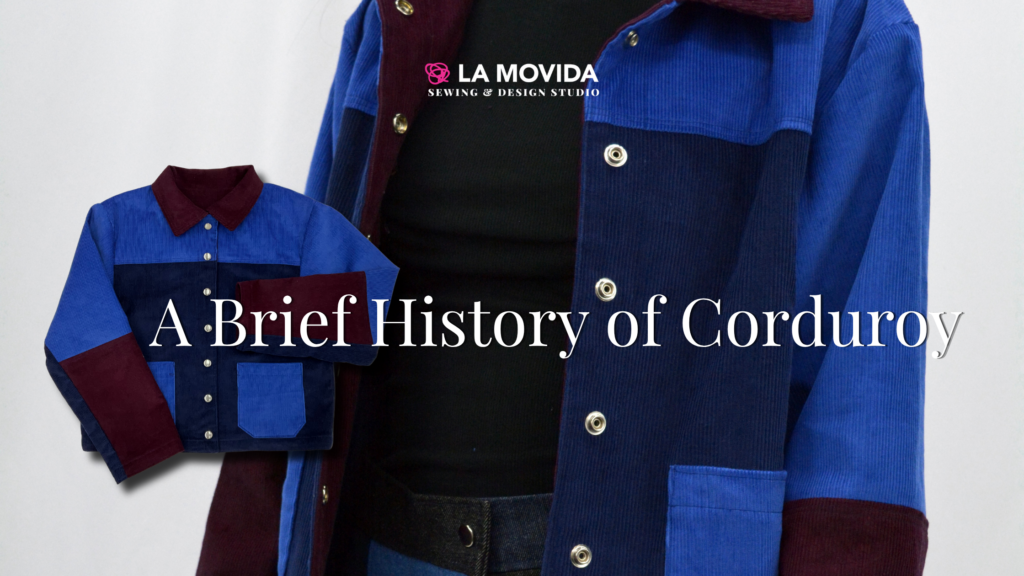
Corduroy is commonly associated with Pants & Jackets nowadays. Once dubbed ‘the poor man’s velvet’. It has been wildly popular in fashion for quite some time now.
But I bet you didn’t know its origins are actually from ancient Egypt.
Al Fustat was Egypt’s first Arab settlement in Egypt in 641 AD and was the country’s first capital. The city was known for their prosperity and they created what is known as Fustian cloth.
Notably at this time spinning wheels were just emerging. Silk as always was very expensive and time consuming to produce and cotton was harder to spin as it had shorter staple (shorter fibers). Hemp and Linen were the most common fiber, as they both have a long staple length (long fibers).
Fustian cloth utilized the strengths of common fiber, using flax as the warp (the longest strings woven) and cotton as the weft (the shortest strings woven). This created a durable cloth that was useful for many things.
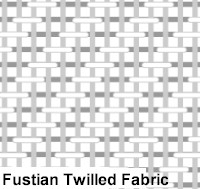
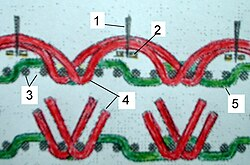
Fustian Cloth is not quite corduroy yet though, it is similar as it has looped ridges but not yet did the technology and thought exist to cut the threads to create the fluffy pile that we know cord for!
During the crusades Al Fustat was left in ashes, believed to be ordered by a political official of Al Fustat in order to prevent opposing forces from gaining their knowledge and riches.
Thankfully though through trade Fustian cloth traveled out of Egypt to medieval Europe.
Eventually to be worn by Catholic priests Vestments (due to the cistercians’ enforcement). As well, later making it to King Henry VIII ‘s closet, utilized to lined his clothes for warmth.
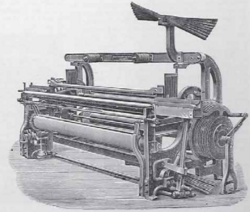
With technological advancement, fustian cloth became more accessible to the masses.
The British were the first to refine the method making it into the Corduroy that we know today.
After mass production was common of corduroy, it fell out of fashion and was seen as more of a poor people fabric (as a lot of fashion does). During the 1960’s it had a resurgence thanks to the Beatles.
Now it comes and goes with the trends, having a bit of a nerdy cool appeal, partially thanks to Wes Andersons love of the fabric.
If you’re on the hunt for corduroy fabric in Canada, we have a variety of colors available in our online fabric shop! Some of the fabric is deadstock as well, making it a really sustainable options.
Corduroy
I (Samantha) love learning more about the origins of fabric and textile tools so this won’t be the last blog on my continued interest. But of course, I am a novice and I encourage you to learn more on your own. Check out my full list of sources below!
Works Cited
Anderson, Freddie. “The History of Corduroy.” Therake.com, The Rake, 23 Aug. 2021, therake.com/ca/stories/the-history-of-corduroy. Accessed 27 Apr. 2026.
Sewport Support Team. “What Is Corduroy Fabric: Properties, How Its Made and Where.” Sewport, sewport.com/fabrics-directory/corduroy-fabric.
Smith, Ernie. “The Long and Bumpy History of Corduroy.” Atlas Obscura, 19 Sept. 2017, www.atlasobscura.com/articles/history-of-corduroy.
“The History of Corduroy.” TOAST, www.toa.st/blogs/magazine/the-history-of-corduroy.
Wikipedia Contributors. “Fustat.” Wikipedia, Wikimedia Foundation, 7 Mar. 2025, en.wikipedia.org/wiki/Fustat.—. “Fustian.” Wikipedia, Wikimedia Foundation, 30 June 2025, en.wikipedia.org/wiki/Fustian