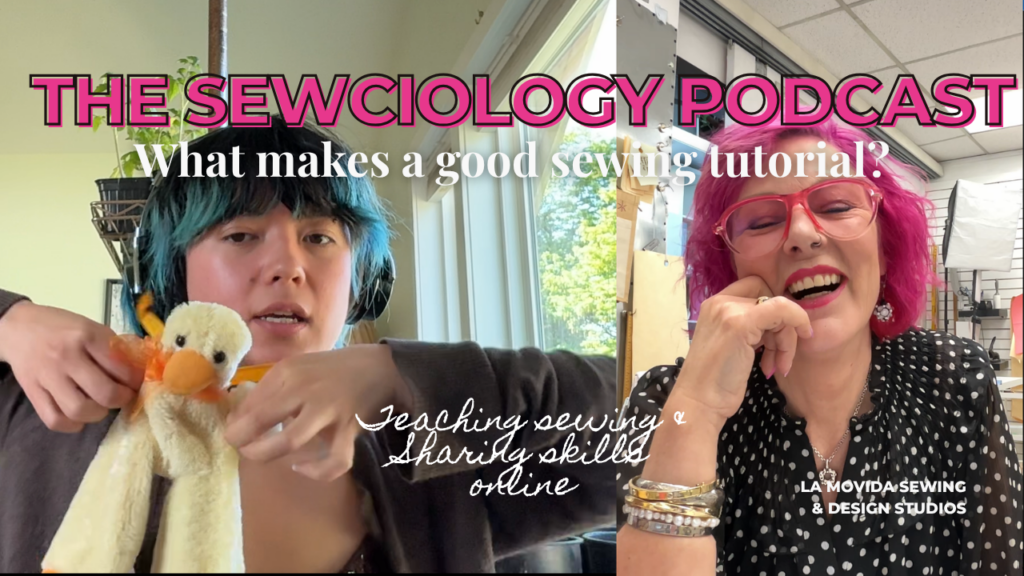
In general what do you look for when watching someones sewing tutorial?
Recently on our Podcast Laurie and I discussed what we look for in a good sewing tutorial. As professional seamstresses who aim to create sewing resources that are accurate and easy to understand, we know how tricky sewing education can be and how much work it takes to provide actually helpful information.
Sometimes watching sewing you can either watch to be entertained or watch for educational purposes, and we want to be clear – anyone who shares the love of sewing is doing cool and important work. So please keep in mind, while we are critiquing the space we are just aiming to provide further information for people who are looking for good resources as well as provide perspective for other sewing educators.
If you’re trying to find a good tutorial to follow I would look at :
- The sewing experience of the person , sewing takes a lot of time to hone and be good at and we don’t generally follow people who just started sewing a year ago
- How ‘quick’ someone is doing something. Lots of the time influencers will try to show you something is quick but good quality fitted clothes take time. You can watch something short or quick but don’t expect it to fix your problems especially when it comes to tailoring.
- What they are telling you about the project. Realistically if you’re sizing something up or down more than 2 sizes you are remaking the garment. Do they think about fabric type, stretch, or finishings?
Sizing things down
The things to note here and with a lot of sewing tutorials is how much they are taking the garment apart.
Lots of the time quick and dirty tutorials will just tell you to pin it and go up with a straight stitch , but especially when you have multiple seams this can result in changes in shaping and more fit issues.
So it is our suggestion when altering a garment down to your fitted size from a oversized piece, that you look for tutorials where the sewist is actually taking apart the seams with a ripper and recreating the proper shaping of the garment.
When the video tutorial is showing you the finished product, look closely at the final fit of the garment, the tip for sleeved shirts is to see how the sleeve cap fits, for pants look at how the crotch and waistband fit.
See our podcast episode critiquing tailoring tiktoks.
Sewings from scratch no pattern
The most common things we notice in poor sewing tutorials that are trying to show you how to make a garment without a sewing pattern is:
- Not accommodating front and back being different
- Not accommodating for fabric stretch or fabric type
These two things are critical because:
The front and back of your body is not the same shape, crotch depth is needed for your butt, space in the front of your shirt is needed for your chest, space at the back of your arm hole is needed for the movement of your arm and the bulk of your shoulder blade.
Fabric stretch plays a big role in how your garment fits, fabric type will also affect drape and how the garment looks on you.
If you have a t-shirt that is high in spandex and you are using that for a template for a t-shirt that is 100% cotton, it will mean that your cotton shirt will not have the same amount of stretch, which may result in your alterations not working.
If you use a denim fabric for a linen pant, your pants will not be flowy, they will be ridged, and if you have an elasticated waist it may be too thick and bunchy around your torso.
Making your own patterns from other clothes
When teaching this method of pattern drafting often online sewing tutorials will show you how to trace out the garment directly but it is important to make sure you are “specing” the garment.
Which is to say, measuring where things land and comparing that to your traced garment.
This is especially important when you have darts or other complicated sewing details.
When everything is all sewn together the flat lay of the garment can get incredibly distorted from the actual original sewing pattern, measuring the garment helps you understand and ensure things are traced out properly, which will prevent fit issues.
So if you are looking for videos on how to do this make sure they are showing you how to properly measure the garment.
My final note is,
it’s not easy, and anyone who is telling you it is, is lying.
Sewing, pattern drafting, and understanding everything in between takes time.
So watch multiple sewing tutorials, read sewing books, and invest into sewing classes.
If fit and tailoring is your end goal, understand that it is an acquired skill that needs to be nurtured.